
Best Yoga Breathing Techniques for Anxiety and Panic Relief

Why Your Breath Is the Most Underrated Tool for Anxiety ?
Most of us have been told to “just breathe” when we’re anxious. And honestly, it can sound a little dismissive especially when your heart is racing and your thoughts are spinning out of control.
But here’s the thing: there’s real science behind it, and more importantly, there’s real practice behind it. Yoga breathing techniques aren’t just a wellness trend. They’re some of the oldest, most studied tools for calming the nervous system and they work when you actually know how to use them.
Whether you experience occasional stress, regular anxiety, or full-on panic episodes, the right breathing technique can shift how your body and mind respond in the moment. It’s not magic. It’s physiology.
This guide walks you through the most effective yoga breathing techniques for anxiety and panic relief explained in plain English, so you can actually try them today.
What Are Yoga Breathing Techniques, Really?
In yoga, breath is called Pranayama which comes from two Sanskrit words: prana (life force or breath) and ayama (to extend or regulate). Together, it means the practice of controlling the breath in a conscious, intentional way.
Now, you don’t need to understand Sanskrit to benefit from it. Think of yoga breathing techniques as structured ways of breathing that go beyond your usual unconscious in-and-out. You’re changing the pace, the depth, the rhythm, and sometimes even which nostril you’re using.
Each technique has a slightly different effect on your body and nervous system. Some are calming. Some are energizing. For anxiety, you’ll mostly want the calming ones and that’s exactly what we’re focusing on here.
How Breathing Affects Anxiety in Your Body ?
Before jumping into the techniques, it helps to understand why they work. When you’re anxious, your body switches into what’s often called “fight or flight” mode. Your heart rate increases, your breathing becomes shallow and fast, your muscles tighten, and your brain starts scanning for threats.
This is your sympathetic nervous system doing its job. The problem is that it doesn’t always know the difference between an actual danger and a stressful email.
Here’s where your breath becomes powerful: slow, controlled breathing activates your parasympathetic nervous system the part of your body responsible for rest, digestion, and calm. When you breathe slowly and deeply, your brain registers safety. Your heart rate slows. Cortisol (your stress hormone) starts to drop.
This is why yoga breathing techniques for anxiety aren’t just “relaxing” they’re actually changing your body’s chemical and neurological state in real time.
The Best Yoga Breathing Techniques for Anxiety and Panic
4.1 Diaphragmatic Breathing (Belly Breathing)
This is the starting point for almost every breathwork practice, and for good reason. Most anxious people breathe from their chest shallow, quick breaths that keep the nervous system activated.
Belly breathing, or diaphragmatic breathing, shifts that pattern.
How to do it:
- Sit comfortably or lie down
- Place one hand on your chest and one on your belly
- Inhale slowly through your nose, letting your belly rise first (not your chest)
- Exhale slowly through your mouth, letting your belly fall
- Aim for 4–5 seconds in, 4–5 seconds out
This technique is ideal for beginners because it doesn’t require any complicated counting or specific ratios. It simply teaches your body what a full, deep breath actually feels like.
Even 5 minutes of this can lower your heart rate noticeably. It’s a good first step if you’ve never done any structured breathwork before.
4.2 Box Breathing (Sama Vritti)
Box breathing is one of the most widely recommended yoga breathing techniques and it’s used by everyone from yoga teachers to military personnel and athletes. Its symmetry makes it easy to remember, especially when anxiety is making it hard to think clearly.
How to do it:
- Inhale for 4 counts
- Hold for 4 counts
- Exhale for 4 counts
- Hold for 4 counts
- Repeat 4–6 cycles
The “box” refers to the four equal sides of the breath. This equal rhythm signals balance to your nervous system and gives your mind something concrete to focus on which is especially helpful during a panic episode when your thoughts feel out of control.
If 4 counts feels too short or too long, adjust it. The point is the symmetry, not the number.
4.3 4-7-8 Breathing
This is often described as a natural tranquilizer for the nervous system. The extended exhale is the key here when your exhale is longer than your inhale, your vagus nerve (which connects your brain to your gut and heart) sends a “calm down” signal throughout your body.
How to do it:
- Inhale quietly through your nose for 4 counts
- Hold your breath for 7 counts
- Exhale completely through your mouth for 8 counts
- Repeat 3–4 cycles
This one is particularly useful before bed if anxiety is keeping you awake, or during the early stages of a panic attack before it escalates. The hold can feel a little uncomfortable at first that’s normal. Start with just 2–3 rounds and build from there.
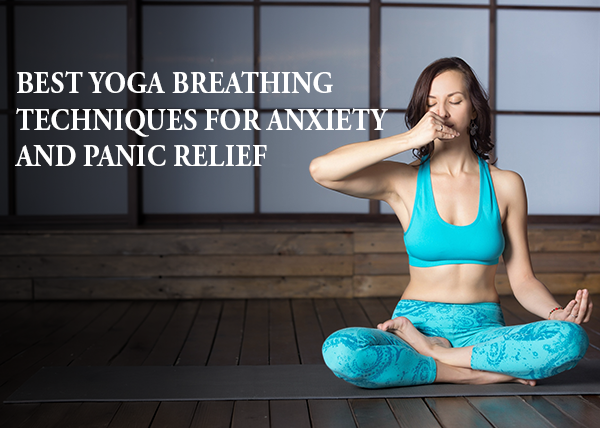
4.4 Alternate Nostril Breathing (Nadi Shodhana)
This is one of the most iconic yoga breathing techniques, and once you try it, you’ll understand why it’s been practiced for thousands of years. It’s gentle, grounding, and surprisingly effective at quieting a noisy, anxious mind.
How to do it:
- Sit comfortably with your spine tall
- Bring your right hand to your face, using your thumb to close your right nostril and your ring finger to close your left
- Close your right nostril with your thumb, inhale through your left nostril for 4 counts
- Close both nostrils, hold briefly
- Release your thumb, exhale through your right nostril for 4 counts
- Inhale through your right nostril for 4 counts
- Close both, hold briefly
- Exhale through your left nostril for 4 counts
- That’s one round do 5–10 rounds
It might feel a bit awkward at first. That’s okay. After a few rounds, most people feel noticeably calmer and more mentally clear. It’s also a wonderful technique to use before meditation or before a difficult conversation.
4.5 Extended Exhale Breathing
Sometimes the simplest techniques are the most powerful. Extended exhale breathing is exactly what it sounds like you make your exhale longer than your inhale.
How to do it:
- Inhale for 4 counts
- Exhale for 6–8 counts
- Repeat for 5–10 minutes
The longer exhale stimulates the vagus nerve and activates your parasympathetic nervous system. You don’t need to count perfectly. Just focus on making the out-breath noticeably longer and slower than the in-breath.
This is one of the easiest yoga breathing techniques to use in public at your desk, in a waiting room, or in a car (as a passenger!) because no one around you will even notice you’re doing it.
4.6 Humming Bee Breath (Bhramari)
This one might feel a little unusual at first, but don’t let that put you off. Bhramari involves making a gentle humming sound as you exhale, and the vibration it creates inside your head and chest has a genuinely calming effect on the nervous system.
How to do it:
- Sit comfortably and close your eyes
- Place your index fingers gently over your ears (or use your thumbs to lightly close the ear flap)
- Inhale deeply through your nose
- On the exhale, make a steady, low humming sound like a bee until you run out of breath
- Repeat 5–7 times
The vibration from the hum stimulates the vagus nerve and can reduce anxiety, lower blood pressure, and create an immediate sense of inner quiet. Many people find it surprisingly emotional the first time they try it. That’s completely normal.
4.7 Ocean Breath (Ujjayi)
If you’ve ever taken a yoga class and heard a soft ocean-like sound in the room that was Ujjayi breath. It’s typically used during physical yoga practice, but it’s also a valuable standalone technique for managing stress and anxiety.
How to do it:
- Breathe in through your nose
- Breathe out through your nose while gently constricting the back of your throat the sound should be soft, like ocean waves or a light snore
- Keep both your inhale and exhale slow and steady
- Aim for 5–7 counts in and 5–7 counts out
The resistance created by the throat constriction slows your breathing down automatically and creates a consistent rhythm. The sound itself also gives your mind something to focus on, which helps interrupt anxious thought patterns.
Quick Comparison: Which Technique Is Right for You?
| Technique | Best For | Difficulty Level | Time Needed |
| Belly Breathing | Complete beginners, daily use | Very Easy | 3–5 mins |
| Box Breathing | Panic episodes, focus, grounding | Easy | 3–5 mins |
| 4-7-8 Breathing | Sleep anxiety, acute stress | Easy–Moderate | 3–4 mins |
| Nadi Shodhana | Mental clarity, deep anxiety relief | Moderate | 5–10 mins |
| Extended Exhale | Quiet stress, daily maintenance | Very Easy | 5–10 mins |
| Bhramari | Emotional anxiety, sensory overwhelm | Moderate | 5–7 mins |
| Ujjayi | During yoga practice, chronic stress | Moderate | Throughout practice |
Common Misconceptions About Breathwork
“I already know how to breathe I don’t need to practice it.”
This is the most common one. Breathing to survive and breathing to regulate your nervous system are very different things. Most of us have developed habits of shallow, chest-based breathing without realizing it. Breathwork teaches you to use your full lung capacity intentionally.
“If I don’t do it perfectly, it won’t work.”
There’s no perfect here. The goal isn’t to count exactly or hold your breath for a precise number of seconds. It’s to slow down, breathe more fully, and give your nervous system a signal of safety. Even an “imperfect” breathwork session is better than no session.
“It’s just a temporary distraction.”
Breathwork changes your physiology. Consistently practicing yoga breathing techniques actually trains your nervous system to be less reactive over time. It’s not just a band-aid it’s building a more resilient baseline.
“It only works for mild anxiety.”
While breathwork isn’t a replacement for professional mental health support in serious cases, many people find it helpful even during intense panic episodes. The key is practicing before a crisis so the technique feels familiar when you need it most.
Who Should Try These Techniques?
Yoga breathing techniques are genuinely suitable for almost everyone. But they’re especially worth exploring if:
- You deal with regular stress, worry, or overthinking
- You experience panic attacks or anxiety episodes
- You have trouble falling or staying asleep due to a busy mind
- You feel emotionally reactive and want more tools to regulate yourself
- You’re new to yoga or meditation and looking for an accessible starting point
- You sit at a desk for long hours and feel tension building in your body
- You want a drug-free way to manage day-to-day stress
If you have any respiratory conditions like asthma or COPD, or if you’re pregnant, it’s worth checking with your healthcare provider before starting any new breathwork practice particularly techniques that involve breath holding.
How to Build a Simple Daily Breathwork Practice ?
You don’t need to spend an hour on this. Even 5–10 minutes a day, consistently, will create a real shift. Here’s a simple way to start:
Week 1: Stick to belly breathing only. Do it for 5 minutes every morning before you look at your phone. That’s it.
Week 2: Add box breathing. Use it any time you feel a moment of stress during the day before a meeting, after a difficult conversation, during a commute.
Week 3: Experiment with one new technique from this list. Try it for 5–7 days before deciding if it resonates.
Week 4 and beyond: You’ll start to naturally reach for breath as a tool. Build a short 10-minute practice that combines two or three techniques in a sequence that feels good to you.
The biggest secret to making breathwork stick isn’t the technique it’s consistency. Even on the days it feels like you’re “just breathing,” you’re still reinforcing the habit and training your nervous system.
What to Expect When You First Start ?
It’s completely normal to feel a little lightheaded the first few times you try any of these yoga breathing techniques, especially if you’re not used to deep breathing. Go slowly and don’t push yourself.
Some people feel emotional during or after breathwork sometimes releasing some unexpected feelings. That’s okay. Breathwork can surface things that have been sitting under the surface, and that’s actually part of how it works.
You might also find that you feel quite sleepy after a session. That’s a good sign your nervous system is shifting out of alert mode. Work with it, not against it.
After a few sessions, most people start noticing:
- A quieter, more settled feeling after practice
- Slightly better sleep quality
- A greater ability to pause before reacting in stressful situations
- More awareness of when their breathing becomes shallow throughout the day
These are all signs the practice is working even if the changes feel gradual at first.
How Canada Yoga Studio Can Help ?
If you want to learn yoga breathing techniques properly with guidance, community, and a structured approach Canada Yoga Studio in Calgary offers exactly that.
Located at 28 St NE, Calgary, AB, the studio is built around personalized yoga, meditation, and breathwork experiences designed to support your overall wellbeing not just give you a workout.
Their weekly Meditation & Breathwork class runs every Thursday at 6:30 AM, and their Meditation for Stress Relief class is every Wednesday at 6:00 PM both specifically designed to help you work with your nervous system through breath and mindful practice.
If you’re not local or prefer to start online, their 30-Day, 30-Hour Online Live Beginner Holistic Yoga Flow Workshop is an excellent option. The four-week program is structured around exactly what this article covers:
- Week 1 focuses on foundational movement and breath awareness to calm an activated nervous system
- Week 2 goes deeper into breathwork and meditation specifically for reducing anxiety and improving sleep
- Week 3 builds strength and lung capacity
- Week 4 is about integration turning everything you’ve learned into a sustainable daily practice
With only 8 participants per cohort, live instruction, WhatsApp support, and a lifetime studio membership included, it’s a genuinely personal experience not just another online course you watch and forget.
Book your spot or reach out to the studio team here →
- Coral Springs, Calgary
- +1 368-997-7429
Come find your breath with us.
FAQs
Q: How quickly do yoga breathing techniques work for anxiety?
Some techniques like box breathing or belly breathing can have a noticeable calming effect within just a few minutes. For longer-term benefits like reduced baseline anxiety and better stress resilience, consistent daily practice over several weeks tends to make the biggest difference.
Q: Can I do breathwork if I’ve never done yoga before?
Absolutely. You don’t need any yoga experience to start with breathwork. Most of the techniques in this article can be done sitting in a chair or lying down. They’re accessible to complete beginners.
Q: How long should I practice each day?
Even 5–10 minutes of intentional breathing daily is enough to see a real difference. You don’t need to set aside a huge block of time just be consistent.
Q: Is breathwork safe during a panic attack?
Yes, gentle techniques like belly breathing and box breathing are generally safe during a panic episode. In fact, they can help interrupt the cycle of fast, shallow breathing that makes panic worse. However, avoid techniques that involve extended breath holds during a full panic episode stick to simpler, rhythmic breathing until things settle.
Q: Can yoga breathing techniques replace therapy or medication for anxiety?
They’re a powerful complementary tool, but not a replacement for professional mental health care when that’s needed. Think of breathwork as something that works alongside whatever support you already have not instead of it.
Q: What’s the best time of day to practice breathwork?
Morning is a popular choice because it sets a calmer tone for the day. Evening practice can help wind down before bed. Honestly, the best time is whenever you’ll actually do it consistently. Even a few minutes at your desk during the workday counts.
Q: What’s the difference between yoga breathing and regular deep breathing?
Regular deep breathing is a step in the right direction, but yoga breathing techniques are more structured. They use specific ratios, rhythms, and patterns that have been refined over centuries to target particular effects like activating the parasympathetic nervous system, balancing the left and right brain hemispheres, or building lung capacity. The structure is what makes them more reliably effective.
Q: Do I need any equipment or a special space to practice?
Nothing at all. A quiet corner, a chair, or a yoga mat is all you need. Some people find it helpful to use a timer or a guided audio to start but ultimately, these techniques are completely self-sufficient.
Final Verdict
Anxiety is genuinely exhausting and the frustrating part is that most of the tools people reach for (scrolling, distraction, caffeine) actually make it worse. Your breath, on the other hand, is something you always have access to.
Yoga breathing techniques won’t eliminate anxiety from your life overnight, and that’s not what they promise to do. What they will do, over time, is give you a reliable way to come back to yourself when things feel overwhelming. They lower your heart rate, settle your nervous system, clear mental noise, and build a calmer baseline over weeks and months of practice.
Start simple. Pick one technique from this list belly breathing is the best starting point and do it for five minutes tomorrow morning. Then the day after. Then the day after that.
If you want to go deeper with proper guidance and community support, Canada Yoga Studio is a genuinely welcoming space to do exactly that, whether you join them in person in Calgary or through their online workshop.
The breath has been here this whole time. You just have to learn how to use it.
Ready to get started? Reach out to the Canada Yoga Studio team today →